
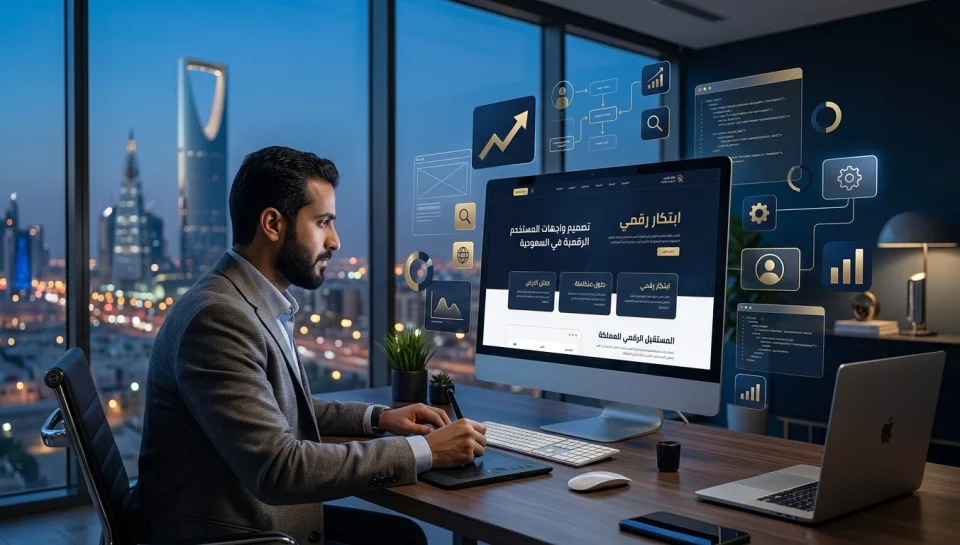
Website design in Saudi Arabia has become one of the most important digital investments needed by companies, organizations, and business owners in light of the rapid growth of e-commerce and digital transformation. A website is no longer merely an introductory interface that displays a company’s name and services; it has become an essential channel for communicating with customers, receiving inquiries and orders, building trust, increasing sales, and establishing a strong presence in search engines.
With increasing competition in the Saudi market, having a professional, fast, mobile-friendly, and search-engine-optimized website has become an important factor in the success of any business. Today, customers search online for a company or service before making a purchasing decision, compare websites, prices, services, and reviews, and therefore, a website that provides an outstanding user experience can be a decisive factor in converting visitors into customers.
In this article, we will explore the importance of website design in Saudi Arabia, the most important criteria that should be considered when creating a website, the difference between a traditional website and a website designed to achieve business objectives, as well as the key stages of website design and the factors that contribute to the success of a website in the Saudi market.
What Does Website Design Mean?
Website design is an integrated process aimed at creating a digital website that combines an attractive design, ease of use, strong technical performance, and appropriate content in order to provide visitors with a complete and engaging experience.
Website design is not limited to choosing colors, images, and fonts. Instead, it includes a range of essential elements, such as:
- User interface design.
- User experience optimization.
- Organizing website pages.
- Writing digital content.
- Improving page loading speed.
- Ensuring compatibility with mobile phones and tablets.
- Optimizing the website for search engines (SEO).
- Adding communication channels and electronic forms.
- Integrating the website with analytics and marketing tools.
- Providing website security and protection.
Therefore, the success of a website depends on the integration of design, development, content, and digital marketing.

Why Is the Demand for Website Design in Saudi Arabia Increasing?
The Saudi market is witnessing significant digital transformation across various sectors, from commerce and services to education, healthcare, real estate, hospitality, restaurants, and consulting. With this transformation, having a digital presence has become a necessity rather than merely an additional option.
Among the most important reasons why companies are increasingly interested in website design in Saudi Arabia are:
1. Reaching a Larger Number of Customers
A website enables a company to reach customers around the clock without being restricted by traditional business hours. Customers can learn about services and products and request more information at any time.
2. Building Trust and Credibility
Having a professional website enhances the brand’s image in the eyes of customers. When visitors find clear information about the company, its services, and its contact methods, they are more likely to feel confident and trust the business.
3. Increasing Sales Opportunities
A website can be transformed into a direct sales channel, whether through an e-commerce store, service request forms, online booking, or direct communication with the sales team.
4. Supporting Digital Marketing
A website serves as a central hub for most digital marketing activities. For example, visitors can be directed from Google Ads and social media platforms to landing pages specifically designed to convert them into customers.
5. Improving Search Engine Visibility
A properly designed website can be optimized for search engines so that it appears when customers search for the services or products offered by the company.
The Most Important Types of Websites in the Saudi Market
Before starting the design process, it is essential to determine the type of website and its primary purpose, because the requirements of a corporate website differ from those of an e-commerce store or an educational platform.
Corporate Websites
Corporate websites are used by companies and organizations to introduce their services and products. They typically include a homepage, About Us page, Services page, Projects or Portfolio page, Blog, Frequently Asked Questions page, and Contact Us page.
E-Commerce Stores
E-commerce stores require more advanced functionalities, such as product pages, shopping carts, electronic payment systems, order management, discount codes, shipping options, and customer accounts.
Service-Based Websites
Service-based websites are suitable for clinics, law firms, consulting companies, real estate offices, and other businesses that primarily focus on providing professional services.
Blogs and News Websites
Blogs and news websites focus on publishing content regularly. They require a well-organized structure that helps both visitors and search engines easily access articles, news, and different topics.
Educational Platforms
Educational platforms require additional features such as user registration, courses, quizzes, videos, certificates, and learning management systems.
What Makes a Professional Website Stand Out?
There is a significant difference between simply creating a website and building a website that serves the objectives of a business. A professional website should combine a range of essential standards and features.
Design That Matches the Visual Identity
The website should reflect the brand identity through its colors, fonts, images, and visual elements. This helps create a consistent and recognizable image of the brand in the customer’s mind.
Ease of Use
Visitors should be able to access the information they need easily. Complicated menus and poorly organized pages may cause users to leave the website.
Mobile Compatibility
Browsing the internet through smartphones has become an essential part of users’ behavior. Therefore, the website must function exceptionally well across different screen sizes.
Website Loading Speed
Website speed is an important element of the user experience. If a page takes too long to load, visitors may leave before viewing the content or completing a purchase.
Search Engine-Friendly Design
It is important to build the website according to SEO fundamentals, starting with page structure, headings, and meta descriptions, and extending to website speed, content, and internal links.
Designing Websites That Are Compatible with the Saudi Market
When implementing website design in Saudi Arabia, it is important to consider the nature of the local audience and the behavior of users in the Saudi market.
It is important for the content to be clear and available in Arabic, with the option of adding English if the business targets international customers, residents, or foreign markets.
It is also important to make communication easy, display company information clearly, and provide appropriate communication channels, such as phone numbers, email, social media platforms, and messaging applications.
For e-commerce stores, particular attention should be paid to the payment and shipping experience, displaying prices and products clearly, and simplifying the checkout process.
The Role of User Experience (UX) in Website Success
User experience is one of the most important elements that affects website performance. It refers to everything a user experiences while browsing and interacting with a website.
When a customer enters a website, they should quickly understand:
- Who is the company?
- What does it offer?
- What problem can it solve?
- How can the customer obtain the service?
- How can the customer get in touch?
- What is the next step they should take?
For this reason, pages should be designed according to a clear user journey, with call-to-action buttons such as “Order Now,” “Book an Appointment,” “Contact Us,” or “Get a Quote.”
The Importance of Content in Website Design
An attractive design alone is not enough. Content is what explains the services and products to customers, answers their questions, and helps the website appear in search engines.
The content should be:
- Clear and direct.
- Useful to the visitor.
- Well organized using headings and paragraphs.
- Compatible with SEO guidelines.
- Free from unnecessary repetition and keyword stuffing.
- Suitable for the target audience.
- Supported by clear calls to action.
A blog can also be created within the website, with specialized articles targeting the keywords customers search for. This helps build a long-term organic presence in search engine results.
Search Engine Optimization (SEO) from the Beginning of the Design Process
One of the common mistakes is creating a website first and thinking about SEO later. It is better to integrate search engine optimization into the design and development stages from the beginning.
This includes choosing an appropriate website structure, creating clear URLs, optimizing titles and meta descriptions, using keywords naturally, optimizing images, and creating internal links between pages.
Local SEO should also be given attention, particularly for companies targeting customers within Saudi Arabia or in specific cities such as Riyadh, Jeddah, Dammam, Tabuk, Medina, and Mecca.
For example, a company can create pages and content targeting its services and the areas in which it operates, while maintaining content quality and avoiding random duplication of texts.
E-Commerce Website Design in Saudi Arabia
E-commerce has become one of the most important digital business models, but the success of an online store does not depend solely on displaying products.
The purchasing journey should be simple and fast, starting from searching for a product and continuing through the completion of payment. The store should also provide clear images, accurate descriptions, and detailed information about prices, shipping, exchanges, and returns.
It is also important to integrate the store with marketing and analytics tools to monitor customer behavior, identify the most-viewed products, and determine which traffic sources generate the highest number of sales.
There are various platforms available in the Saudi market that can be used to create e-commerce stores. The appropriate solution depends on the size of the project, the nature of the products, the available budget, and the required features.
Stages of Website Design in Saudi Arabia
A professional website goes through several essential stages:
Stage One: Project Analysis
The nature of the business, target audience, competitors, and marketing objectives are studied and understood.
Stage Two: Defining the Website Structure
The main pages and their relationships are determined, along with a clear concept of the user journey.
Stage Three: Interface Design
The visual design of the website is prepared according to the brand identity and target audience.
Stage Four: Development and Programming
The design is converted into a functional website, the required features are added, and forms, databases, and external services are integrated when necessary.
Stage Five: Content Entry
Texts, images, products, services, and informational pages are prepared and added to the website.
Stage Six: Testing
The website is tested on smartphones, computers, and different browsers, in addition to testing forms, links, and functionalities.
Stage Seven: SEO Optimization
Technical elements, content, headings, links, and essential data are optimized.
Stage Eight: Launch and Monitoring
After launching the website, the monitoring, analysis, and continuous optimization stage begins based on user data and website performance.
How to Choose a Website Design Company in Saudi Arabia
Choosing a website design company should not depend on price alone. It is better to evaluate several factors before making a decision.
Review Previous Work
A company’s portfolio helps you understand its level of expertise and experience in designing different types of websites.
Understand the Services Provided
It is preferable to choose a company that provides integrated solutions including design, development, SEO, and technical support if the project requires these services.
Ensure Mobile Compatibility
You should make sure that the company’s previous websites work well on smartphones and tablets.
Ask About Support and Maintenance
A website requires updates, maintenance, and technical issue resolution. Therefore, you should find out whether the company provides support after the website is launched.
Understand the Workflow
It is important to understand the project stages, expected timeline, available revisions, and the method of website delivery.
Focus on Results
The goal should not simply be to own a beautiful website. Instead, the website should be capable of achieving measurable objectives, such as increasing inquiries, bookings, sales, or potential customers.
Mistakes to Avoid When Designing Websites
There are several mistakes that can reduce the effectiveness of a website. The most important include:
Focusing on Appearance and Ignoring Functionality: An attractive design is important, but it should serve the user experience and the business objective.
Ignoring Mobile Devices: A website that works well only on computers may lose a significant percentage of its users.
Using Weak Content: Repetitive or unhelpful content does not contribute to building trust or improving visibility in search results.
Ignoring Website Speed: Large images and unnecessary software or scripts can negatively affect loading speed.
Having No Clear Call to Action: Users should know what they are expected to do after reading a page.
Failing to Update the Website: A website is not a project that ends at launch; it requires continuous development and improvement.
How Much Does Website Design Cost in Saudi Arabia?
There is no fixed cost for all websites because the price depends on the size, complexity, and required functionalities of the project.
For example, the price of a simple corporate website differs from that of an e-commerce store containing hundreds of products. Likewise, the cost of an educational platform or an integrated booking system differs from that of a traditional service-based website.
Factors that affect the cost include:
- The number of website pages.
- The type of design.
- The level of customization.
- The number of languages.
- Required features and software.
- Integration with external systems.
- E-commerce functionality and electronic payment.
- Content writing.
- SEO services.
- Hosting, support, and maintenance.
Therefore, it is best to define the project’s objectives and requirements first, and then request a detailed quotation specifying the services included in the project.
The Future of Website Design in Saudi Arabia
With the continued digital transformation, the expansion of e-commerce, and the increasing reliance of companies on data, automation, and artificial intelligence, websites are expected to become more advanced in terms of personalization and interaction.
Some of the trends that may influence the future of websites include:
- Using artificial intelligence for customer service.
- Intelligent chatbots.
- Personalization based on user behavior.
- Voice search.
- Improving the mobile shopping experience.
- Integration between websites and social media platforms.
- Advanced analytics.
- Marketing automation.
- Continuous improvement of the user experience.
This means that a successful website will no longer be merely a static page. Instead, it will be an integrated digital platform that helps a company communicate with customers, analyze their behavior, and achieve its business objectives.

Why Is a Website Considered a Long-Term Investment?
Some business owners may view a website as an expense, while it can instead be considered a digital asset with the potential for continuous growth.
When a well-designed website is created, optimized for search engines, and consistently updated with useful content, it can continue to attract visitors and customers for long periods of time.
A website also gives a company its own digital space, rather than relying entirely on social media platforms whose algorithms or policies may change over time.
Therefore, investing in website design in Saudi Arabia should be part of an integrated digital strategy that includes SEO, content marketing, advertising, social media, and data analysis.
Conclusion
Website design in Saudi Arabia has become an essential element in building a strong digital presence and achieving growth in the Saudi market. A successful website does not depend solely on visual appeal; rather, it combines ease of use, speed, mobile compatibility, high-quality content, search engine optimization, security, and the ability to convert visitors into customers.
Therefore, before choosing a website design company, it is important to define the project’s objectives, target audience, required functionalities, and available budget, and then select the solution that provides the best balance between quality, performance, and results.
Ultimately, a professional website has become one of the most important digital assets for any company seeking to compete and grow in Saudi Arabia. The more effectively a website is designed according to a clear strategy that combines user experience, technology, content, and digital marketing, the greater its ability to attract customers and achieve tangible and sustainable results.