
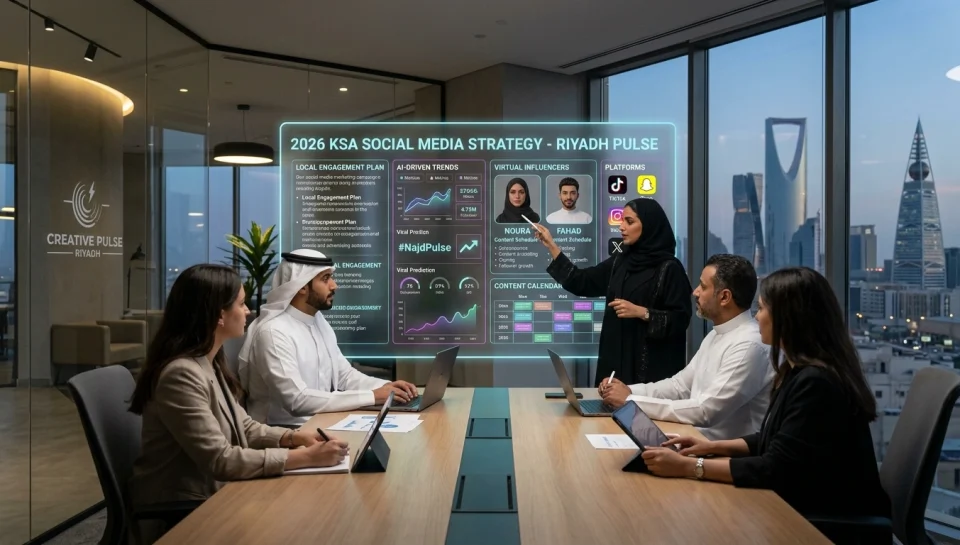
Social Media Marketing is witnessing rapid development in the digital marketing sector in the Kingdom of Saudi Arabia, in conjunction with the growing digital transformation, changing consumer behavior, and increasing reliance on digital channels for searching, comparing, and purchasing. Simply having a website or active accounts on social media platforms is no longer sufficient to achieve a strong presence in the market. Instead, companies now need integrated strategies that combine content, data, advertising, search engine optimization, and digital identity building.
In 2026, digital competition has become increasingly dependent on the quality of the experience a brand provides to its audience, rather than simply the number of followers or the size of the advertising budget. Therefore, a range of new trends is emerging that companies and entrepreneurs in Saudi Arabia can leverage to reach customers, increase sales, and build long-term relationships with them.
Why Is Digital Marketing Changing Rapidly in Saudi Arabia?
The Saudi market is one of the most active digital markets in the region. It is characterized by high smartphone usage and widespread use of social media platforms, in addition to the growth of e-commerce and digital services. With this development, customers have become more aware of brands and more capable of comparing products and services before making a purchasing decision.
This change requires companies to continuously develop their approaches. Today’s consumer is not simply looking for a good product; they also care about how quickly they can access information, the clarity of prices, the quality of content, customer reviews, ease of communication, and the overall experience of the website.
For this reason, Social Media Marketing has become an essential part of the modern marketing ecosystem, rather than merely an additional channel for publishing advertisements.

The Top Digital Marketing Trends in Saudi Arabia for 2026
1. Short-Form Content Takes Center Stage in the Digital Landscape
Short-form video has become one of the most important tools for capturing attention online. Digital platforms give companies the opportunity to deliver fast and direct marketing messages that can be easily consumed through mobile devices.
Saudi companies can leverage short-form video to:
- Showcase products and services.
- Provide quick tips and solutions.
- Answer customers’ questions.
- Share customer experiences.
- Showcase behind-the-scenes activities.
- Promote seasonal offers.
- Introduce the brand and its team.
However, success does not depend solely on publishing a large number of videos. Instead, it depends on providing content that delivers genuine value and aligns with the interests of the target audience.
2. TikTok Has Become an Important Marketing Channel for Brands
TikTok is no longer limited to entertainment content. It has become one of the channels that companies can leverage to build brand awareness and reach different segments of their target audience.
TikTok for marketing provides multiple opportunities for brands, particularly when organic content, paid advertising, and collaboration with content creators are combined.
Some of the most effective approaches that can be implemented on TikTok include:
- Providing short educational content.
- Using stories and real-life situations.
- Showcasing products in an indirect and natural way.
- Leveraging user-generated content.
- Collaborating with influencers whose audiences align with the nature of the product.
- Testing multiple ideas and monitoring the results.
Most importantly, businesses should avoid turning their accounts into spaces for direct advertising all the time, as users tend to engage more with content that feels useful, entertaining, or relatable to their everyday experiences.
3. Influencer Marketing Is Shifting Toward Quality Rather Than Follower Count
Influencer marketing has undergone significant development in recent years. The number of followers is no longer the only factor companies rely on when selecting the right influencer.
In 2026, it has become important to evaluate audience quality, engagement rate, content type, the influencer’s relevance to the brand, as well as the audience’s location, interests, and purchasing behavior.
Collaborating with a specialized influencer who has a smaller but more engaged audience that is genuinely interested in the product may be more effective than collaborating with a personality who has millions of followers but whose audience is not targeted or relevant.
Therefore, companies should measure campaign performance through clear indicators such as:
- Website visits.
- Engagement with content.
- Use of promotional codes.
- Inquiries.
- Leads.
- Sales.
- Return on Investment (ROI).
4. Artificial Intelligence Is Entering Every Stage of Marketing
Artificial intelligence has become one of the most important tools helping marketing teams work more efficiently. It can be used for data analysis, idea generation, content personalization, customer behavior analysis, and assisting with campaign preparation.
However, using artificial intelligence does not mean abandoning the human element. Brands that achieve better results are those that use technology to accelerate their work while maintaining creativity and a genuine understanding of their audience.
Practical applications of artificial intelligence in marketing include:
- Analyzing campaign performance.
- Identifying topics that attract the most attention from the audience.
- Suggesting content ideas.
- Segmenting audiences into different groups.
- Improving marketing messages.
- Analyzing customer comments.
- Assisting with customer service.
5. Local Search Engine Optimization Has Become More Important
For companies that provide their services in a specific city or region, local SEO represents an important opportunity to reach customers who are searching for nearby services.
When a user searches for a service or product in a specific city, appearing in local search results can increase the chances of receiving inquiries, visits, and purchases.
To improve their local presence, companies can focus on:
- Optimizing their Google Business Profile.
- Clearly adding contact information and location details.
- Using local keywords.
- Creating dedicated pages for the targeted cities and regions.
- Obtaining genuine customer reviews.
- Publishing content related to the local market.
- Keeping company information consistent across different platforms.
Local SEO should not be viewed simply as adding the name of a city to keywords. Instead, businesses should build a comprehensive local digital presence that accurately reflects their activities, location, and services.
6. Websites Are Transforming from Informational Interfaces into Sales Tools
A website is no longer merely a digital business card for a company. In 2026, it has become an essential part of the customer journey.
A customer may begin their journey with a post on social media, then visit the website to obtain additional information, compare prices or services, and eventually contact the company or make a purchase directly.
Therefore, a website should be:
- Fast-loading.
- Mobile-friendly.
- Clearly designed.
- Easy to navigate.
- Secure.
- Optimized for search engines.
- Equipped with clear calls to action.
Service and product pages should also contain sufficient information to help customers make informed decisions rather than relying solely on generic text.
7. User Experience Has Become Part of the Marketing Strategy
An advertising campaign may successfully attract thousands of visitors to a website, but if the page is slow, complicated, or unclear, users may leave without completing any action.
For this reason, user experience has become an essential element of digital marketing.
A good user experience includes:
- Easy access to information.
- Clear headings.
- Simple navigation.
- Fast website performance.
- Clear contact and purchase buttons.
- A mobile-friendly design.
- Reducing the number of steps required to complete a transaction.
This highlights the connection between marketing and the website. A successful campaign does not end when a visitor is attracted; rather, an important stage begins once that visitor reaches the website.
8. Content Is Becoming More Specialized and Personalized
In 2026, audiences are increasingly drawn to content that speaks to them directly and addresses their genuine needs.
Instead of creating generic content such as “We are the best company in the market,” a brand can provide content that explains a specific problem and offers a practical solution.
For example, a digital marketing company can publish content about:
- How to increase visibility in search results.
- Common advertising campaign mistakes.
- Ways to improve landing pages.
- How to choose the right social media platform.
- How to measure marketing results.
This type of content helps build trust, increases the website’s chances of appearing in search engine results, and positions the company as an expert in the eyes of potential customers.
9. Digital Identity Has Become a Critical Factor in Building Trust
Digital identity is not limited to the logo, colors, and fonts used in a design. It encompasses the overall image that the audience forms about a brand online.
Digital identity is reflected through:
- The website.
- Social media accounts.
- Writing style.
- Images and designs.
- The way customers are responded to.
- User reviews.
- Published content.
- Search results for the brand.
When these elements are consistent, it becomes easier for customers to remember the brand and recognize it across different digital channels.
10. User-Generated Content Is Becoming More Influential
Content created by customers or users gives a brand an additional level of credibility, as audiences often value the experiences of real people before making a purchasing decision.
Companies can encourage customers to share:
- Their experiences with the product.
- Photos of themselves using the products.
- Their reviews and ratings.
- Videos.
- Success stories.
- Questions and answers.
Companies can then repurpose this content, after obtaining the necessary permissions, in marketing campaigns, product pages, and social media platforms.
How Can Saudi Companies Integrate Their Websites with Social Media?
One of the most common mistakes is treating the website and social media platforms as separate channels.
The most effective strategy is to connect all channels as part of a single customer journey.
For example:
Social media post → Website visit → Content consumption → Contact → Offer presentation → Purchase completion → Retargeting.
In this way, every part of the digital ecosystem supports the others.
Social media platforms help attract attention, while the website provides information and helps turn that interest into a meaningful action.
How to Measure Digital Marketing Success in 2026
The number of followers or likes is not a sufficient indicator for evaluating the success of a marketing strategy.
Companies should define performance indicators that are directly linked to their business objectives, such as:
- Number of leads.
- Customer acquisition cost.
- Conversion rate.
- Number of sales.
- Average order value.
- Returning customer rate.
- Organic website traffic.
- Content engagement.
- Return on Ad Spend (ROAS).
By analyzing this data, a company can identify which channels are delivering the best results and allocate its budget accordingly.
Mistakes to Avoid in Saudi Digital Marketing
Despite the availability of numerous tools and platforms, some companies make mistakes that negatively affect the results of their campaigns. Some of the most common include:
Relying on a Single Platform
Platform algorithms and audience behavior are constantly changing. Therefore, it is better to build a diverse digital ecosystem rather than depend entirely on one platform.
Focusing on the Number of Followers
Followers do not necessarily represent potential customers. What matters most is reaching the right audience and achieving measurable business results.
Neglecting the Website
Driving customers to a weak or slow website can result in losing the opportunity that the company has already paid to generate.
Publishing Content Without a Strategy
Consistent publishing without clearly defining the target audience, objectives, and key messages often leads to limited results.
Failing to Analyze Data
Without data, it is difficult to determine why one campaign succeeded while another failed.
The Future of Digital Marketing in Saudi Arabia
As digital transformation continues across the Kingdom, e-commerce develops, and reliance on digital services increases, competition for audience attention is expected to become even stronger.
This means that companies will not only need larger marketing budgets, but also smarter and more precise strategies.
The integration of artificial intelligence, visual content, data analysis, influencer marketing, search engine optimization, user experience, and digital identity will be among the key elements for building a strong digital presence.
Conclusion
Social Media Marketing and website marketing in Saudi Arabia are entering a new phase based on the integration of technology, content, data, and an understanding of customer behavior.
Several important trends are emerging in 2026, including the rise of short-form video, the growing use of TikTok for marketing, the development of influencer marketing, and the increasing importance of local SEO, alongside a stronger focus on user experience and building a strong digital identity.
To achieve sustainable results, it is not enough to follow every new trend. Instead, businesses should select the trends that align with the nature of their activities, target audience, and business objectives, then measure their results and continuously improve their strategies.
In a rapidly evolving Saudi market, brands that invest in an integrated digital presence, valuable content, an outstanding user experience, and data-driven decision-making will be better positioned to attract customers, convert them into loyal customers, and build a sustainable competitive advantage.